
Tucker, GA · Garage Door Service
Off-Track Doors on Candler-McAfee's 1960s Housing Stock
Candler-McAfee homes mostly date to the early 1960s, and their steel doors ride tracks that have outlived the rollers. Tucker Garage Door Pros fixes off-track doors here.
- Repairs & new doors
- Springs & openers
- Serving 5 nearby communities
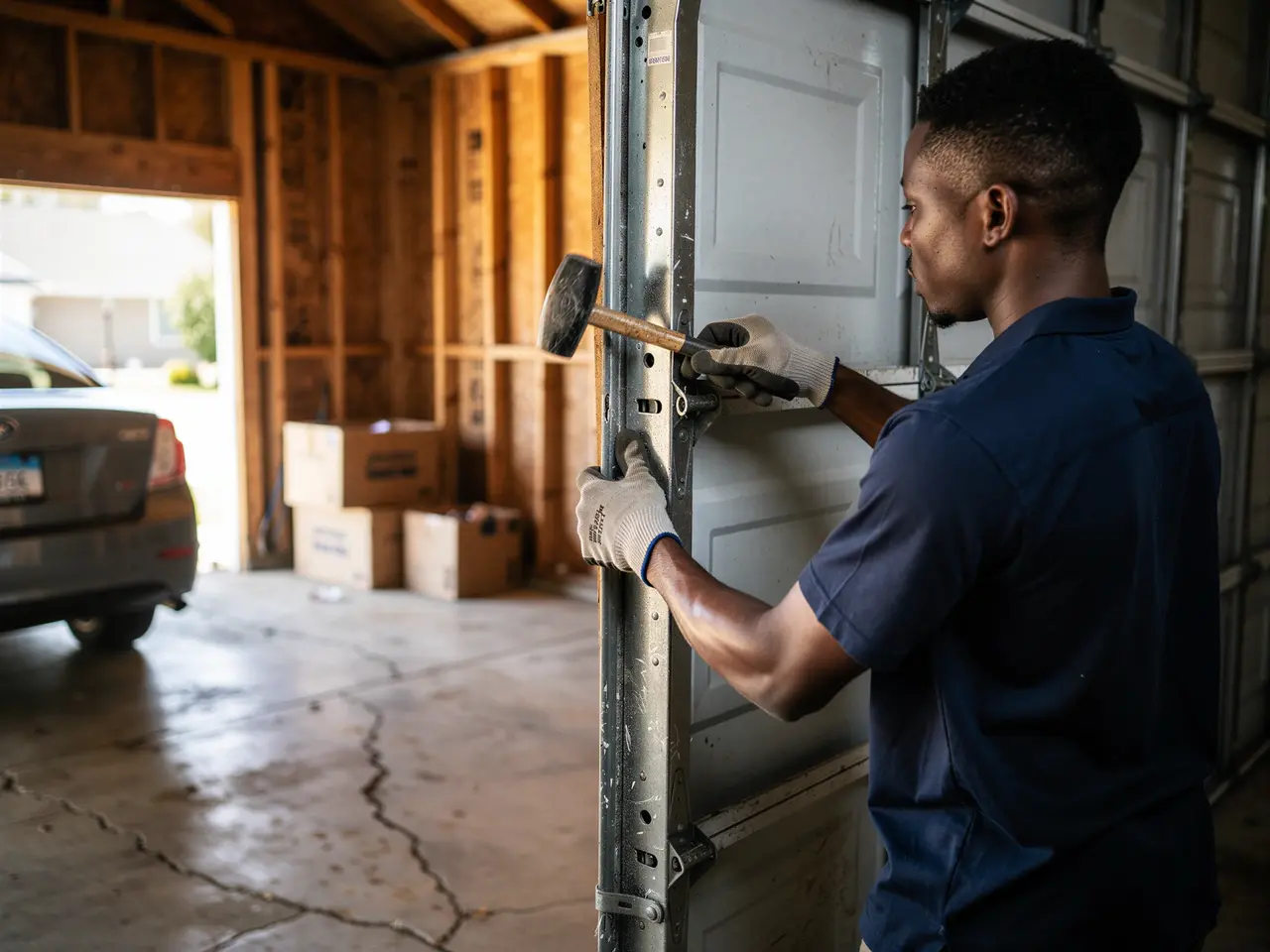
Why This Fails Locally
Most houses in Candler-McAfee went up around 1963, which puts the garage doors squarely in the single-layer steel era - flat panels, no insulation core, hung on narrow steel tracks that were never meant to carry fifty-plus years of daily cycles. Those original tracks flex more than current ones, and the galvanized coating on a lot of them has worn thin enough that rollers start walking sideways instead of riding straight. Once a roller leaves the track channel on one side, the door racks in its opening, binds against the stop molding, and on the next pull it jumps the rail entirely.
This isn't a Candler-McAfee problem because of anything unusual about the area - it's a Candler-McAfee problem because of when the area was built. A door from 1963 has had three times as many open-close cycles as one installed in the last fifteen years, and the hardware shows it: bent track flanges, stretched roller stems, brackets that have loosened at the lag screws. We see this pattern across the older pockets of the wider service area, but it's especially consistent here given how much of the housing clusters in that early-1960s window.
A door that's off-track once usually comes back off-track within weeks if the track itself isn't straightened or swapped, not just the roller that popped out.
What It Costs
We don't have a flat number to quote you here, and giving one without seeing the door would be a guess, not a quote - the cost depends on whether the track bent, whether a roller needs replacing, and whether the opener forced the door hard enough to crack a stile. What we can tell you is what changes the number: a single bent track section is a different job than track on both sides, and a door that was forced while off-track sometimes needs a panel, not just hardware.
Candler-McAfee's median household income sits at $62,299, a bit under the wider service area's $70,101, and we mention that only because it's relevant to one real trade-off: on a door this old, sometimes a track repair buys you another few years, and sometimes the door itself is tired enough that putting new hardware on it is throwing money at a panel that's going to warp or rust through anyway. We'll tell you which one you're looking at before we start, not after.
How It Shows Up
The door hangs crooked in the opening - one side higher than the other by an inch or two, sometimes more. You hear a grinding or scraping sound from inside the track as the door moves, rather than the smooth roll it used to have. The opener strains, chain or screw drive working harder than it should, sometimes stalling partway and reversing on its own.
On a lot of the 1960s-era doors still in service here, the first sign is subtler: the door starts binding right near the top, where the track curves into the horizontal run. That curved section is exactly where decades of imperfect alignment finally catch up to the metal, and it's usually the last few inches of travel that reveal a roller has already left the channel further down. If you keep running the opener through the binding, you're loading stress onto a stile or hinge that didn't cause the problem in the first place.
Can You Do This Yourself
If a roller has only partly slipped and the door is still roughly square in the frame, some people manage to walk it back into the track with a pry bar and a lot of care - but a door this age, on original hardware, is a bad candidate for that attempt. The steel has fatigue in it you can't see, and forcing a roller back in on a track that's already bent a few degrees often just pops it out again on the next cycle, or cracks a stile under the pressure.
What you can safely do yourself: disconnect the opener, so it stops trying to drive a door that's binding, and don't keep running it through resistance hoping it'll work itself out. That alone prevents most of the secondary damage we see - stripped drive gears, torn panels, bent brackets that used to just be bent track. Past that point, specifically with doors from this era, it's a job for someone who can tell whether the track needs straightening or replacing, and whether the spring tension is still safe to work near.
Booking a Visit
We run from Tucker, about 9 miles out, so we're not sitting in Candler-McAfee waiting on calls - we come when you book one. That's worth knowing up front: we don't carry a local branch here, just a truck that covers this stretch of the service area along with the other communities nearby.
When you call, tell us roughly how the door is hanging - crooked, jammed partway, or fully derailed on one side - and whether the opener is still trying to run it. That tells us what to bring. See the full rundown of off-track repair work on our main service page, or check who else nearby we cover from Tucker.
Frequently asked questions
Why do so many doors in Candler-McAfee go off-track around the same age?
Most of the housing here dates to around 1963, which means the original steel doors are riding on track and rollers from the same era. That hardware has had decades of cycles to wear, bend, or rust, so track failure clusters in houses of this age rather than being random.
Is it ever cheaper to replace the door instead of fixing the track?
Sometimes. If the door is original from the 1960s and the panels are already rusted or warped, putting new track and rollers on it can be money spent on a door that fails again soon anyway. We'll look at the panel condition, not just the track, before recommending a fix.
Do you have a crew based in Candler-McAfee?
No. We work out of Tucker, about 9 miles away, and come to Candler-McAfee on booked calls. We don't keep a local branch or stock here, so we tell you what we can bring based on what you describe over the phone.
Can I keep using the opener if the door is off-track?
Don't. Running the opener against a binding or derailed door puts load on the panel, hinges, and drive gear that aren't built to take it. Disconnect the opener by hand and leave the door where it is until it's looked at.
More garage door services in Candler Mcafee
Book garage door service in Tucker
Call now or request a quote - tell us what the door is doing and where you are.