
Tucker, GA · Garage Door Service
When a Spring Breaks in Cold Weather in Tucker
Why torsion springs snap in cold weather on Tucker's older housing stock, what you can wait on, what drives the cost, and what the climate here does to the hardware.
- Repairs & new doors
- Springs & openers
- Serving 5 nearby communities
When Waiting Is Fine
Not every broken spring is an emergency. If the door is down, the opener is unplugged, and nobody's trying to force it open by hand, a snapped torsion spring can sit overnight or over a weekend without making things worse. The door just sits heavy - it's not going anywhere on its own.
What changes that calculus is the hardware underneath it. Tucker's housing stock runs mostly 1960s and 70s construction, with the broader build window stretching from 1951 to 2012 and a median year around 1974. A lot of these garages still carry original or first-generation replacement spring setups - galvanized torsion springs on side-mounted brackets that were common on that era's builder-grade doors. On a house that age, a break often means the whole spring is past its rated cycle life, not just unlucky timing, and the cable or bearing plate next to it may be close behind.
So waiting is fine if the door is secured and nobody's forcing it. It stops being fine the moment someone tries to drive the opener anyway, because that's how a cable snaps or a panel bends. We'd rather get a call for a scheduled visit than a call for a door that's now off its track.
One honest limit: we can't quote a same-day fix without seeing the spring size and the bracket style in person, because older setups don't always match today's standard parts.
The Situation
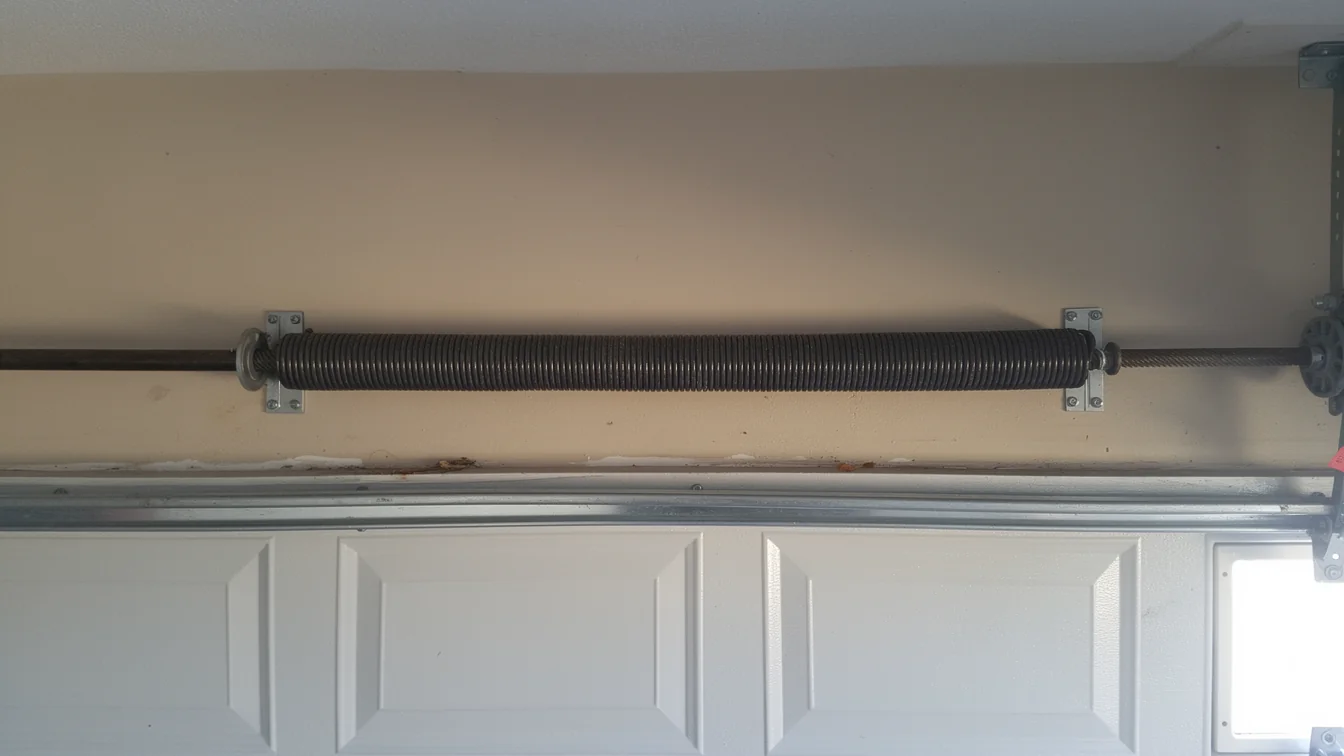
A torsion spring breaks at the weakest point in the wind, usually near a winding cone or where rust has eaten into the coil. On homes built in the 1950s through the 1970s - which describes a large share of Tucker's housing - that weak point is often decades old. These springs were sized for the door and the opener of their era, and many haven't been touched since the house was built around 1974.
The break itself is loud. People describe it as a gunshot or a car backfiring in the garage, and it's startling enough that neighbors sometimes come check on things. After it happens, the door won't lift, or it lifts a few inches and stalls, because the spring that was carrying most of the door's weight is no longer doing that job. The opener motor isn't built to lift a full garage door on its own, and trying forces the gears.
On the older end of Tucker's housing stock, we also see single springs on doors that would call for two by today's standard, because that's how builders spec'd them decades back. Replacing like-for-like isn't always the right call - sometimes the safer fix is bringing the setup up to a two-spring configuration, especially on a wider double door.
What It Costs
We're not going to put a number here that doesn't hold up once we see your actual spring, door size, and bracket setup - a quote given blind is a quote that gets revised on arrival, and that's not fair to you.
What we can say is what drives the number up or down. A single spring on a standard single door costs less than a matched pair on a double door. A door still running its original 1960s or 70s hardware sometimes needs a bracket or shaft replaced alongside the spring, because the old parts don't always pair cleanly with current stock sizes. That's more common on Tucker's older housing than it is on newer builds.
The other variable is whether it's just the spring or whether the cable, drum, or bearing went with it. A spring snapping under tension can take a cable with it, and that's a different job than a clean spring swap.
Our honest limitation: if your door is original to a house built before the 1970s and the track or hardware is heavily rusted, sometimes replacing the door is the better call rather than patching one more part onto an aging system. We'll tell you that straight if we see it.
What the Weather Here Does to It
Tucker sits in a moderate cold-weather band - not the hard freezes you'd get further north, but enough cold swings through winter to matter for steel under tension. Torsion springs are wound tight and stay that way for years. When metal contracts in cold temperatures, that tension increases slightly, and a spring that was already fatigued from age or rust has less room to flex before it gives. Cold mornings are a common time for an old spring to finally let go, not because the cold caused the damage, but because it's the final push on a spring already near its limit.
Moisture plays into it too. Humidity and temperature swings through the year encourage surface rust on springs that live in an unheated, unsealed garage, which is most garages. Rust pits the coil, and a pitted coil breaks sooner under the same load than a clean one would.
None of this means every cold morning brings a spring failure. It means a spring that was already near the end of its life - which, given how much of Tucker's housing dates to the 1960s and 70s, describes a lot of springs out there - is more likely to pick a cold morning to finally go.
Frequently asked questions
Why did my spring break on a cold morning and not during the summer?
Cold doesn't cause the damage, but steel contracts slightly in colder temperatures, which adds a bit more tension to a spring that's already wound tight. If the spring was already worn or rusted from age, that small added tension is often enough to be the last straw. It's usually the final push on a spring that was already near the end of its life.
Is it safe to leave my garage door down overnight after a spring breaks?
Yes, as long as the door is fully down and nobody tries to open it by hand or with the opener. A broken spring just means the door is heavy - it won't move on its own while it's resting on the track. The risk comes from forcing it, not from waiting.
My house was built in the 1960s - does that make my spring repair different?
Often, yes. A lot of garages from that era in this area were built with a single spring where a double door would call for two by today's standard, or with bracket hardware that doesn't match current stock sizes. We check what's actually on the door before quoting, rather than assuming it matches a newer setup.
Can I just replace the spring myself?
We'd advise against it. A torsion spring is under enough tension to cause serious injury if the winding cone slips, and the tools for it aren't something most homeowners keep around. If you're comfortable with the cost of a service call, it's worth having it done by someone who does this regularly.
Related garage door services in Tucker
More garage door guides
Book garage door service in Tucker
Call now or request a quote - tell us what the door is doing and where you are.